

When you apply for a mortgage, the lender has to verify your income, employment and assets in order to gain confidence in your ability to repay the mortgage loan and provide proof of funds for a down payment and/or closing costs, when applicable. In the past, lenders have relied on manual verification methods, which include phone calls to employers to verify employment and manual processing of paper documentation, resulting in longer review times, frustrating delays and a poorer experience for borrowers.
Eventually, financial institutions started using software to verify critical information. For example, income and employment verification software lets lenders verify an applicant’s income and employment without contacting employers or waiting for HR reps to provide verification letters.
Truv is taking automation to the next level with consumer-permissioned verification, which streamlines the verification process and improves the applicant experience. These FAQs answer common questions from individuals seeking a fast, secure verification process.
What Is Consumer-Permissioned Verification?
Consumer-permissioned verification of income and employment occurs when a lender has direct access to the records maintained by employers and payroll providers through consumers authenticating access digitally. For example, some landlords use consumer-permissioned verification to determine if an applicant meets their rental guidelines. Some auto lenders use consumer-permissioned verification to determine if a consumer meets the requirement for a vehicle purchase. Some employers use consumer-permissioned data when conducting background checks.
For consumers, digital income and employment verification offers peace of mind and control over who can access your personal information. In short, with Truv’s consumer-permissioned approach to verifications, you permit lenders, landlords and employers to view your data, making the process more secure.
If you value your privacy, consumer-permissioned verification offers several benefits over traditional methods.
Why Choose Consumer-Permissioned Verification Over Traditional Methods?
Traditional verification methods are time-consuming and prone to human error. Managers don’t always have time to provide employee verifications, causing them to wait days or weeks to comply with each verification request. The longer your employer waits to respond, the longer it takes to get your mortgage or rental application approved.
Data breaches are also a concern, as several people have access to your personal information. In some income verification examples, department managers, HR representatives, loan officers and mortgage brokers can see where you work and how much you earn.
Digital solutions streamline the verification process, limiting access to your personal information. Additionally, Truv connects to more than 2.3 million employers and more than 13,000 financial institutions, making it easier for you to verify income, employment and assets.
What Information Is Shared in a Consumer-Permissioned Verification?
Consumer-permissioned verification typically gives the requesting individual access to your salary history, employment dates and job title. No one can access your data unless you give permission.
Truv takes several steps to protect your sensitive information, such as meeting the SOC2 Type II standards, using application-level data encryption and continuously monitoring its controls. As a result, Truv employment verification and other solutions are extremely secure.
How Does Consumer-Permissioned Verification Work?
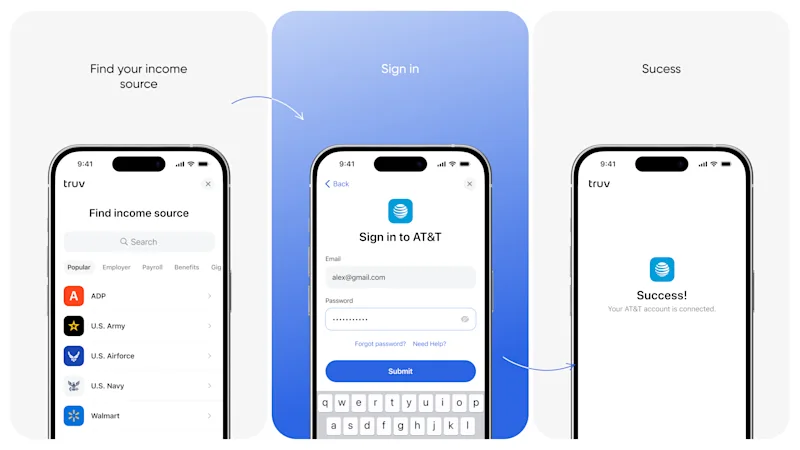
The consumer-permissioned income and employment verification process involves several simple steps:
- The requesting party explains the meaning of income verification and other verification types, ensuring you understand why they’re needed.
- You consent to sharing your employment and income data by credentialing into your payroll provider and/or bank accounts.
- The Truv platform securely retrieves the data and shares it with the requesting party (lender, employer or landlord).
- The verification is completed securely and accurately.
For asset verifications, the process is nearly identical, but instead of connecting to payroll providers to retrieve income and employment details, Truv safely connects to your financial institution/bank to retrieve the details required by your lender following.
Consumer-permissioned verification methods are quick, averaging 30-second login times, and make the process as easy as possible without the need for a paper chase and manual uploads.
What Are Some Common Uses for Consumer-Permissioned Verification?
While consumer-permissioned income and employment verifications can be beneficial to a variety of organizations and consumers, below are three common scenarios:
- Mortgage applications: Lenders verify your income and employment to ensure you can afford monthly mortgage payments. Verification also helps lenders reduce the risk of loan defaults.
- Rental applications: When applying for a rental, your landlord needs to know you earn enough to pay rent. Verification helps determine your earnings.
- Employment background checks: Many employers conduct background checks to ensure they hire qualified employees. Employment verification makes confirming a candidate’s credentials and salary history easy, enabling hiring managers to make better decisions.
How Does Consumer-Permissioned Verification Compare to Other Automated Methods?
Consumer-permissioned verification isn’t the same as using third-party-led software to perform income and employment verification. When lenders, landlords and employers use third-party-led verification software, you don’t have to give them permission to access personal information. This makes the process less secure.
Some organizations rely on third-party data aggregators to collect information about applicants. For example, an instant database creates partnership with employers and payroll providers to exclusively share data. That instant database then sells the data to mortgage lenders, auto lenders, background screeners, and more, to access income and employment details without your consent.
This method introduces the potential for errors. For example, Truv’s data retrieval is real-time and has the ability to pull the most active employment status and income details directly from the payroll provider, whereas the instant database is relying on the payroll provider/employer to share details, which are often stale and not up-to-date. They may report inaccurate information, which requires the lender to request documents from you and take additional time to manually review them, leading to delays and slower time to close on your loan.
Consumer-permissioned income and employment verification systems give users control over their personal data. As a result, you know no one can access your income and employment history without your authorization.
Does Truv Use Consumer-Permissioned Verification?
Truv uses consumer-permissioned verification in its processes, allowing users to consent to sharing employment and income data with trusted third parties. When you use Truv, you remain in control of your data. Only approved lenders, employers or landlords can access your information.
As noted previously, Truv uses industry-leading security practices to speed up the verification process without compromising your privacy, so you don’t have to worry about data security.


