

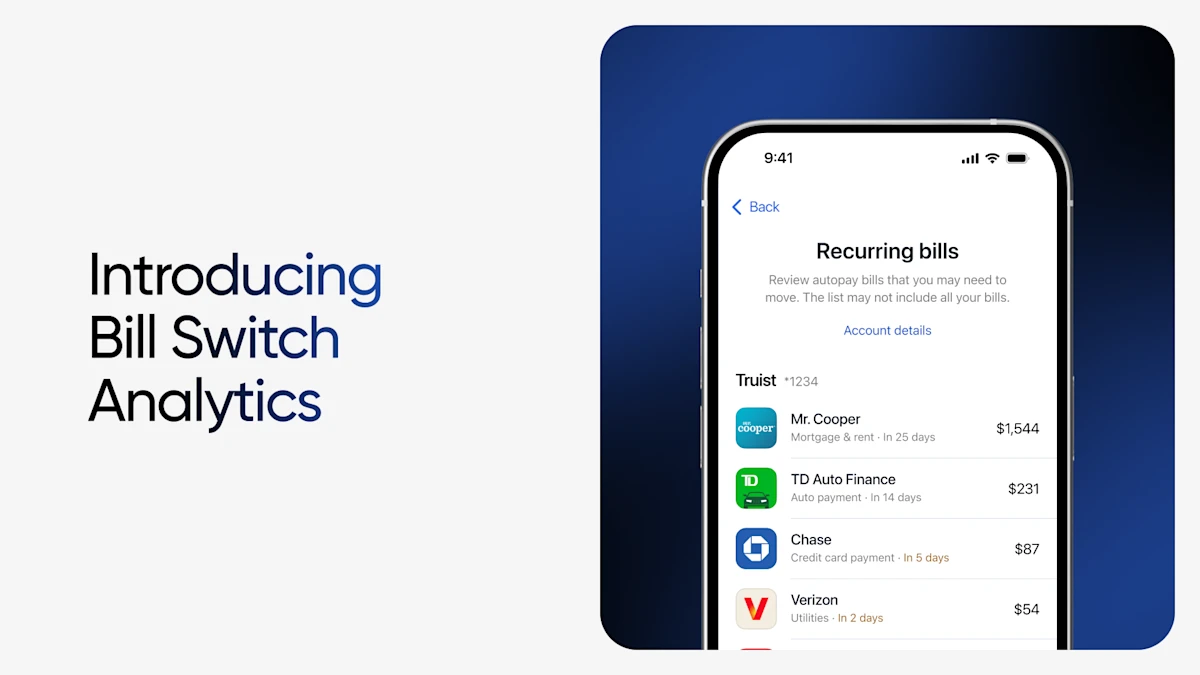
Moving a direct deposit is an important step in making a new bank or credit union account primary. But it’s only one piece of the equation.
Even after members move their paycheck, recurring payments like utilities, insurance, loan payments, credit cards, and subscriptions may still be connected to their previous accounts. In fact, Truv’s partner feedback indicates that 30–50% of users don’t move their recurring payments after switching direct deposit, limiting the value financial institutions can capture from the new relationship.
That’s why we’re introducing Bill Switch Analytics, a new experience designed to help members identify and move recurring payments after completing a Direct Deposit Switch (DDS).
With Bill Switch Analytics, financial institutions can create a more complete account-switching experience, helping members move their paycheck upfront and the financial activity that comes with it down the line.
Going beyond switching the paycheck
Direct deposit switching is often the first step toward making an account primary, but members may have recurring payments spread across multiple financial institutions. Manually identifying every bill connected to an old account can be time-consuming, and missing one can lead to failed or missed payments.
Bill Switch Analytics was designed to remove the friction and identify all the auto-payments that need to be switched to avoid incurring penalties.
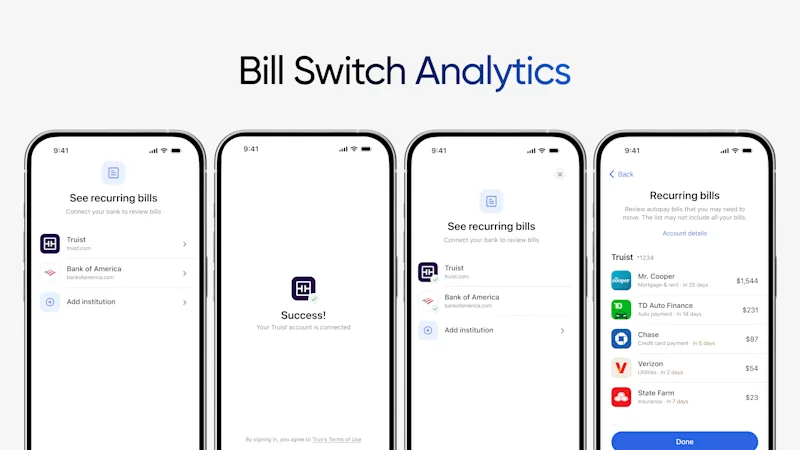
After a Direct Deposit Switch is completed, our solution can now identify the financial institutions receiving the member’s paycheck and enable the member to securely connect relevant accounts. Then, the Bill Switch Analytics solution analyzes transaction activity to identify and display recurring payments that may need to be updated for the member.
Instead of searching through statements or trying to remember every automatic payment, members get one streamlined view of recurring payments.
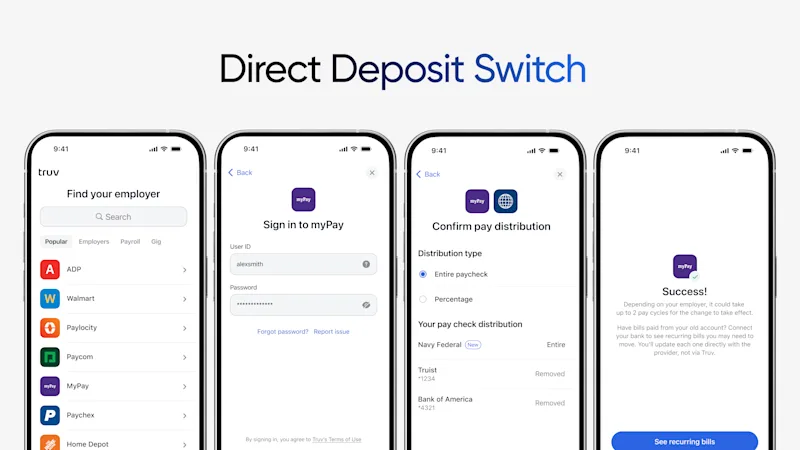
Automatically identify recurring payments
Bill Switch Analytics combines Truv’s bank aggregation infrastructure with transaction categorization and recurring-payment detection to identify bills across connected accounts.
On the back end, we clean up complex transaction descriptions and organize recurring payments into recognizable merchants and categories.
For example, an unclear transaction descriptor can be simplified into a recognizable merchant like Netflix, while recurring payments can be organized across categories including:
- Mortgage and rent
- Utilities
- Credit card payments
- Subscriptions
- Insurance
- Auto loans
Additionally, our solution also filters transaction noise to help prevent unrelated or one-time purchases from appearing as bills that need to be switched.
The result is a clear, actionable list of payments members can work through as they transition their financial life to their new account.
Members can also save the auto-populated snapshot list of recurring bills as a downloadable PDF, so they can switch payments at their own pace.
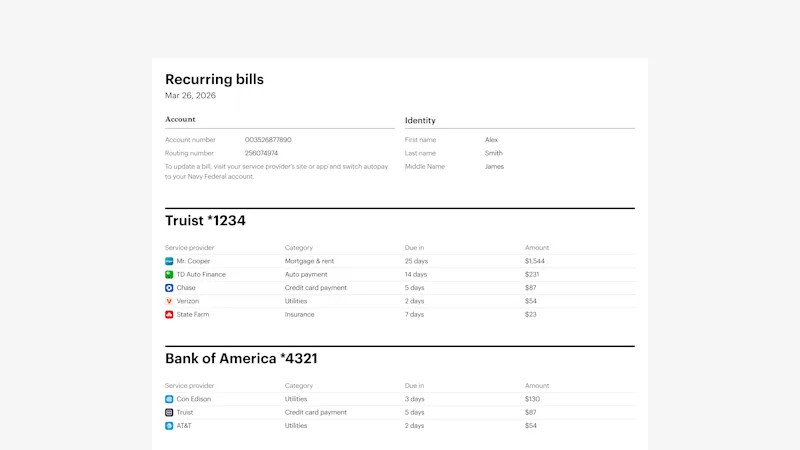
A guided experience from deposit switch to bill switch
The experience builds directly on the Deposit Switch workflow.
With DDS, members first find their employer, authenticate with their payroll provider, and select where they want their paycheck distributed. Once the Deposit Switch is complete, they can continue into Bill Switch Analytics, for those members who did an entire switch.
From there, members can connect their financial accounts where their existing bills are being paid. We identify recurring payments and present them in a centralized bill list, including upcoming payments and amounts.
For bills that can't be switched automatically, members can view the routing and account information they'll need to update the payment directly with the service provider.
This creates an intuitive process, in one single motion:
Move your paycheck → Connect your accounts → Find your recurring bills → Update your payments. That’s it!
Help turn newly opened accounts into primary accounts
For financial institutions, Bill Switch Analytics addresses an important challenge: a funded account isn't necessarily a primary account.
When members continue paying their mortgage, utilities, credit cards, insurance, and other recurring expenses from another institution, significant financial activity remains outside the new relationship.
By pairing Direct Deposit Switch with Bill Switch Analytics, financial institutions can help members consolidate more of their financial activity in one place, to:
- Increase usage of newly opened and funded accounts
- Drive deeper member engagement after account opening
- Reduce friction during account transitions
- Improve retention and primary-account adoption
- Create additional opportunities to engage members with relevant financial products
One connected account-switching experience
With Deposit Switch + Bill Switch Analytics, Truv gives financial institutions the infrastructure to help members move more of their financial lives with an easy, fully digital, and embedded experience.
The result is a simpler transition for members and a stronger path from account opening → funding → primary account adoption for financial institutions.


