
Truv vs The Work Number
Truv vs The Work Number.
Tap into real-time, consumer-permissioned income and employment verification — without the per-hit pricing, stale records, or coverage gaps of legacy databases like The Work Number.
Platform vs database
Two fundamentally different verification models.
Two fundamentally different verification models.
Consumer-permissioned verification platform
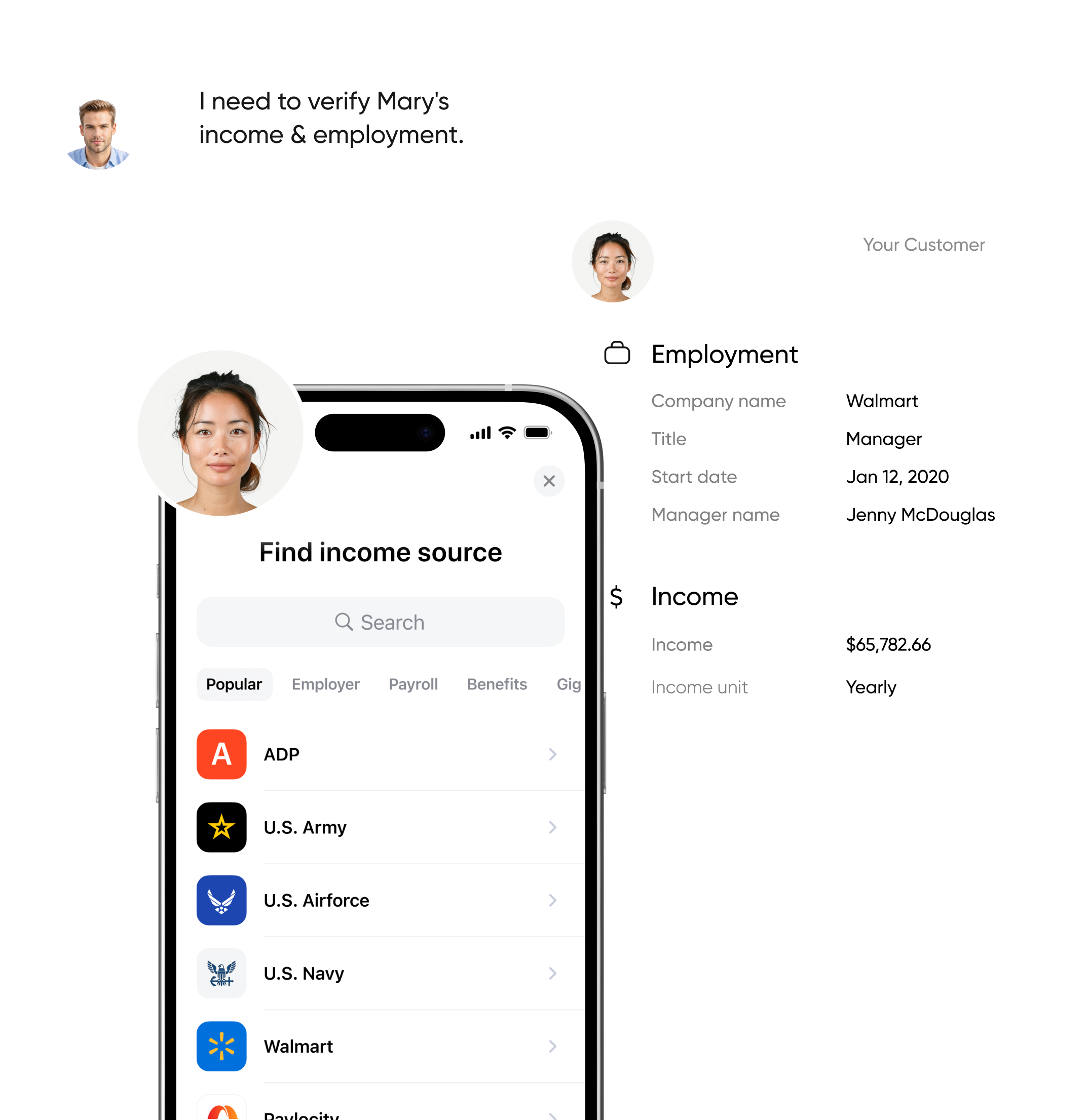
A direct-to-source data platform that pulls payroll, self-employed, wage earner, bank, education, and volunteer data with consumer authentication. Truv owns the technology end-to-end, powering faster product enhancement and innovation cycles, removing costly middlemen, and delivering real-time data at a fraction of legacy costs.
- Direct API connections to payroll providers, employers, and financial institutions
- Data refreshed in real time, permissioned by the consumer
- Pricing based on data completeness: pay for complete reports only
Third-party employment data broker
A legacy verification solution that sources data from exclusive partnerships with employers and payroll providers, operating as an instant database that sells access to income and employment data at premium rates. You are charged per database match (“hit”), including the initial pull, refreshes, and co-applicants, regardless of data completeness.
- Mix of payroll/employer partnerships and active/inactive employer records
- Data refreshed per pay cycle, with risk of stale records
- Pricing based on database “hits”
Why buyers are switching
The case for change.
The case for change.
Cost
The Work Number's per-hit pricing keeps escalating, with overage fees, date-range filters, and charges for incomplete reports.
Up to 80% cost savings with predictable, transparent pricing. Pay for complete reports only, with no overages or hidden fees.
Coverage
A single database with systematic blind spots for military, benefits, gig, and self-employed workers.
Real-time, source-verified data through direct connections and API integrations into 93+ payroll providers, with coverage of 96% of the U.S. workforce, self-employed, gig, disability, retirement, earned income, unearned income, and 14,000+ financial institutions.
Freshness
Records are only as current as the last payroll file an employer submitted — often weeks behind by the next pay cycle.
Direct-to-source connections deliver consumer-permissioned, real-time data the moment it's needed.
Conversion
A database “hit” doesn't mean a successful verification — an employer may be covered, but the data may not be retrieved in full or may be missing required fields.
Truv's end-to-end conversion measurement ensures you pay only for reports that are complete with actionable data.
See how Truv powers your industry.
See how Truv powers your industry.
Truv vs The Work Number, answered.
Truv vs The Work Number, answered.
Truv is the leading alternative to The Work Number. Rather than a legacy database that charges per “hit,” Truv is a consumer-permissioned verification platform that connects directly to payroll providers, employers, and financial institutions in real time — covering 96% of the U.S. workforce with up to 80% cost savings versus The Work Number.
The Work Number (Equifax) is an instant database: it resells employment and income records sourced through employer and payroll partnerships, and bills per database match. Truv is a direct-to-source platform: the consumer permissions a real-time connection to their payroll, employer, or bank, and Truv returns the verification — including original pay stubs and W2s. The result is fresher data, broader coverage, and predictable pricing.
Most customers save up to 80% by moving from The Work Number to Truv. The Work Number charges per “hit” — including initial pulls, refreshes, and each co-applicant, even when a report is incomplete. Truv uses transparent pricing based on data completeness, so you pay only for complete, actionable reports with no overage or hidden fees.
Truv covers approximately 96% of the U.S. workforce — including segments where database-only providers have blind spots, such as military, government benefits, gig, and self-employed workers.
Some of Truv's clients switch to using Truv only. Some use Truv first and rely on The Work Number or manual methods as fallback options. Truv provides verification of income, employment, wage earner income, self-employed income, assets, and original income-document-based verifications (pay stubs, W2s) for a wide range of industries spanning mortgage lenders, public sector, auto lenders, consumer lenders, banks, credit unions, tenant screeners, and background screeners.
The Work Number's records are only as current as the last payroll file an employer submitted, which can be weeks old by the next pay cycle. Because Truv connects directly to the source with the consumer's permission at the moment of verification, the data is real time.
Yes. Truv operates as a consumer-permissioned platform and supports FCRA-compliant verification workflows. You can review Truv's security and compliance posture at trust.truv.com.
Truv offers pre-built integrations with major loan origination systems and point-of-sale platforms for mortgage lenders, plus custom integrations, a modern API and no-code options, so most teams implement in days to weeks, not months.